
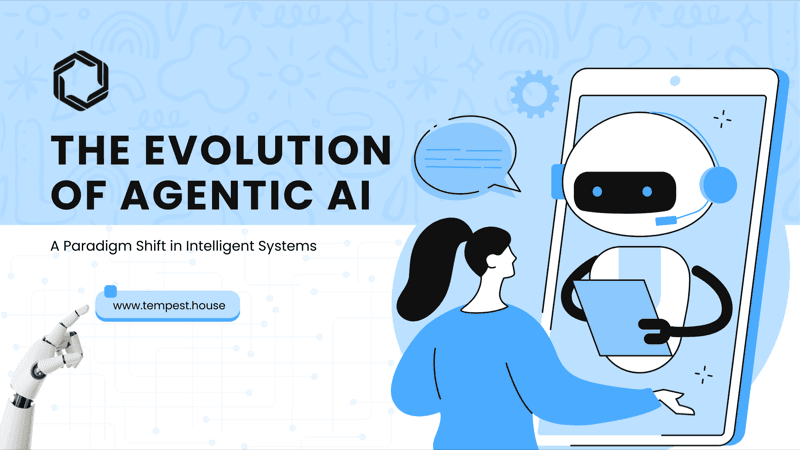
Agentic AI represents a groundbreaking shift in how we think about and interact with intelligent systems. These systems are characterized by autonomy, adaptability, and goal-based decision-making capabilities that redefine the boundaries of machine intelligence.
What is Agentic AI?
Agentic AI encompasses systems designed to function as autonomous agents capable of environmental perception, goal reasoning, and action-taking. Unlike traditional AI, agentic systems learn and evolve, making them ideal for dynamic and complex environments.
Key characteristics include:
- Autonomy: Operating independently without constant human guidance.
- Adaptability: Evolving through new information and environmental changes.
- Goal-Oriented Behavior: Pursuing objectives with minimal external direction.
- Interactive Decision-Making: Collaborating with other agents or humans.
The Evolution of Agentic AI
The development of agentic AI can be traced through five major milestones:
1. Rule-Based Systems
Early frameworks using predefined rules that were effective in controlled settings but lacking in flexibility. These systems could only handle scenarios explicitly programmed into them.
2. Machine Learning
The introduction of pattern recognition from data enabled more responsive systems, though they were still limited within the scope of their training data.
3. Deep Learning
Advanced data processing capabilities established the foundations for autonomous decision-making, allowing systems to handle more complex and nuanced tasks.
4. Reinforcement Learning
Goal-oriented systems that learn through environmental interaction and action feedback marked a significant step toward true autonomy. These systems could optimize their behavior based on rewards and penalties.
5. Agentic AI
The current frontier integrates cognitive science and multi-agent systems for independent decision-making and collaboration. These systems combine the best of all previous approaches while adding true autonomous reasoning capabilities.
Challenges and Considerations
The technology presents several obstacles that must be addressed:
- Ethical Concerns: Maintaining fairness, transparency, and accountability in AI decision-making processes.
- Security Risks: Preventing malicious attacks and misuse of autonomous systems.
- Technical Complexity: Balancing autonomy with appropriate system control and oversight.
- Regulatory Compliance: Following evolving legal frameworks that govern AI technologies.
Tempest House's Role in Agentic AI
Tempest House is committed to leveraging agentic AI for digital transformation. Our approach centers on human-centric design, intelligent software development, and workflow optimization. We position ourselves at the forefront of this paradigm shift, helping organizations harness the power of agentic AI while maintaining responsible and ethical practices.